


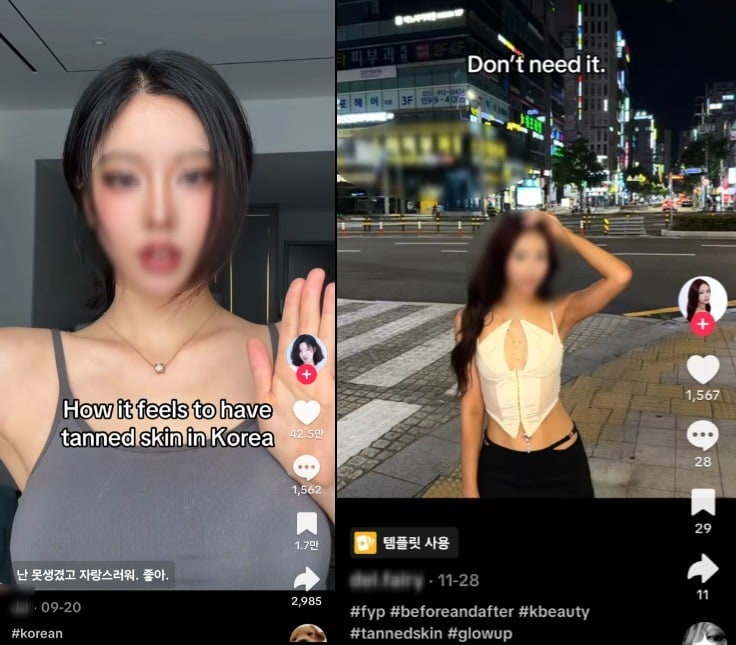
The so-called ‘tanned skin challenge,’ directly targeting Korea's ‘white skin’ aesthetic, is rapidly spreading across Southeast Asia. These creators define ‘white skin’ as the Korean beauty standard and are producing content in protest against it.
As of the 9th, a TikTok video by an Indonesian influencer themed “Rejecting Korean Beauty” surpassed 1.2 million views. Other related videos surrounding skin tone are also rapidly spreading, garnering millions of views and hundreds of thousands of likes.
Posts featuring phrases like “Reject Korean beauty standards” or hashtags such as ‘kbeauty’ and ‘tanned skin’ are spreading like a meme.
“Can't hear compliments about skin tone in Korea?”

The ‘Tanned Skin Challenge’ challenges the tendency to prioritize fair skin as the standard of beauty, emphasizing the appeal of brown skin.
Influencers point out in videos that “Korean idols are styled with excessively pale skin and makeup,” adding that “these standards are distorting the aesthetic ideals across all of Asia.” Videos of women with darker skin tones declaring “I'm ugly and I'm proud” and spreading messages of self-affirmation are also proliferating.
Some TikTok users fuel the debate by sharing personal experiences in Korea. One user who lived there stated, “In Korea, they won't tell you you're pretty unless you have light skin,” adding, “Only after I lightened my skin tone in photos did they finally say I was pretty.”
Another user posted a video comparing Koreans' actual skin tones to their edited SNS skin tones, criticizing, “Korea seems like a country where you're judged not by your real skin, but by your SNS skin.”
Adding to this, unverified stories are spreading about Koreans getting glutathione injections or whitening injections to lighten their skin.

Some accounts repeatedly make baseless claims that singer IU received skin-whitening injections, offering exaggerated analyses such as “Korean skincare is essentially a bleaching culture.” Foreign comments also frequently include definitive reactions like, “Koreans look good with brown skin, yet everyone bleaches their skin,” and “There were clearly more dark-skinned people in the early 2000s, but now they wear makeup too artificially.”
Within Southeast Asia-based overseas communities, claims about Koreans' actual skin color are also spreading, stating, “They aren't as white as you'd think.” Alongside claims like “Their skin tone isn't significantly different from Chinese or Indonesian people” and “Many have a yellowish tint,” the argument that “Skin color discrimination exists in Korean society too” is being raised, further complicating the debate.
Southeast Asia also caught in whitening craze... Global whitening market reached 13 trillion won last year
However, some users countered, “Isn't the preference for fair skin the same in Southeast Asia?” suggesting that singling out Korea is an overinterpretation.

According to market research firm Fortune Business Insights, the global skin-whitening product market reached $9.37 billion last year. This market is projected to grow to $10.22 billion this year and expand to $16.42 billion (approximately KRW 24.1521 trillion) by 2032.
The compound annual growth rate (CAGR) over this period is projected to be 6.85%, indicating steady growth. Notably, the Asia-Pacific region accounted for an overwhelming 55.60% of the total market in 2024, demonstrating the widespread preference for fair skin across Asia.
According to analysis by market research firm Deep Market Insights, the Southeast Asian skin whitening agent market size was valued at $223.83 million last year and is projected to grow to $375.52 million by 2033.
The compound annual growth rate (CAGR) from this year through 2033 is 5.94%. Among product types, creams and lotions held the highest market share in 2024. Conversely, masks and patches are projected to show the fastest growth during the forecast period and are expected to emerge as the most profitable product category going forward.
These figures lend weight to the argument that “the preference for fair skin is not unique to Korea but an enduring aesthetic standard across Asia.”
A dermatology clinic director in Seoul's Gangnam District stated, “The preference for whitening or clear skin has been consistent, not only among Southeast Asian visitors but also across Korea, China, and Japan,” adding, “Foreigners account for up to 80% of all patients, with many seeking skin lightening and various treatments.”
original post: here
1. Yeah... just say whatever you want....
2. But they don't even have fair skin to begin with so what's there to be repulsed about?
3. Do whatever you want then
4. Just love yourself
5. So Korea is this popular huh....
6. I don't care about fair or white skin. I just like skin that is firm and in good condition
7. But they are the ones being triggered by fair skin
8. If you want to be pretty, then just follow your own country's beauty standards
9. Love yourself
10. Their obsession is f*cking intense. We don't care about your guys' skinㅋㅋㅋㅋㅋ